
Architecting Global Customs, Trade Compliance, Governance & Indirect Tax
A structured advisory model for customs, trade compliance, governance and indirect tax across UK–EU and international trade.
CSA Nexus supports companies in structuring customs, trade compliance, sanctions, origin, valuation and VAT-adjacent complexity into clearer operating models, stronger governance and more reliable cross-border execution.
Built for businesses where customs, finance, operations and compliance no longer fit together cleanly.
The first discussion is rarely about a generic service label. It is usually about repeated friction between customs treatment, broker instructions, supplier or product data, sanctions or ownership checks, valuation logic, VAT consequences and management visibility.
Trade compliance here includes REACH, RoHS, CE/UKCA, CBAM, SPS and other product or regulatory trade-compliance layers where they shape cross-border execution.
The advisory layer matters when the file is technically arguable on paper, but operationally unstable in practice.
Which decision really drives the risk, how it should translate into broker and internal instructions, and what management should be able to see before the next exception becomes a repeating cost or governance issue.
An advisory model clients can actually buy and use
CSA Nexus is presented as a working architecture rather than a flat capability list: entry diagnostics, scoped advisory projects, retained support and tailored enablement for clients that need stronger control without building a heavy structure from day one.
The value sits in reducing avoidable friction, weak escalation, repeated broker rework, late authority surprises and the hidden cost of disconnected technical decisions.
Diagnostic / Entry Services
Short reviews used to isolate the real pressure point: corridor design, controls gap, valuation exposure, origin weakness, VAT-adjacent friction or governance blind spots.
Advisory Projects
Scoped workstreams for remediation, operating-model redesign, technical review, policy architecture, authority-ready evidence and cross-functional alignment.
Fractional / Retained Support
Ongoing senior support where the client needs judgement, escalation discipline and continuity without hiring a full internal cross-border trade leadership layer immediately.
Tailored Enablement / Digital Layer
Practical tooling, decision aids, controlled documentation and supervised enablement used to make the operating model more repeatable rather than more theoretical.
| Commercial form | How the relationship usually reads | Typical remuneration logic |
|---|---|---|
| Diagnostic / entry review | A bounded first step used to isolate the real control, corridor or governance issue before a larger commitment is made. | Most often a fixed-fee scope with defined outputs, decision points and a clearer recommendation on next steps. |
| Advisory project | A scoped workstream for origin, valuation, export controls, trade-compliance redesign, trust architecture or cross-border operating model repair. | Usually project-based, sometimes phased or milestone-linked where the work naturally breaks into evidence, design and implementation layers. |
| Retained / fractional support | An ongoing relationship where management needs continuity of judgement, escalation support and cross-functional oversight. | Typically structured as recurring support, fractional leadership coverage or a hybrid framework rather than a one-off consulting package. |
| Enablement / hybrid model | Used when the mandate needs templates, controlled tooling, dashboards, supervised digital support or a more value-sensitive structure around repeat use. | Can sit alongside fixed-fee or retained work, and in selected cases may include hybrid or value-linked elements where the economic logic is genuinely measurable. |
The public site should show how the technical chain actually hangs together.
The advisory model is strongest when it explains where customs governance starts upstream, which themes overlap in the same mandate and why the service architecture creates value before a shipment block, audit challenge or board-level escalation forces the issue.
Product facts, BOM traceability, classification, origin, valuation, controls, broker instructions and finance alignment should read as one operating chain rather than isolated opinions.
| Technical layer | What usually breaks | Why clients buy support |
|---|---|---|
| Customs governance, HS and broker instructions | Classification logic drifts away from product facts and repeated declarations start relying on weak instructions. | To reduce recurring queries, mismatched declarations and avoidable post-clearance exposure. |
| Origin, BOM traceability and FTA use | Preferential claims survive on supplier assumptions with no durable refresh cycle. | To protect margin, support preference decisions and avoid weak evidence packs under review. |
| Valuation, TP adjacency and VAT-linked friction | Finance, customs and broker execution are working from different stories of the same value chain. | To prevent hidden landed-cost leakage, late corrections and avoidable customs-accounting tension. |
| Export controls, sanctions and cross-border release logic | Screening is performed, but ownership, route logic and US exposure are not tied into a usable release record. | To make legitimate trade more reliable while preserving a defensible control narrative. |
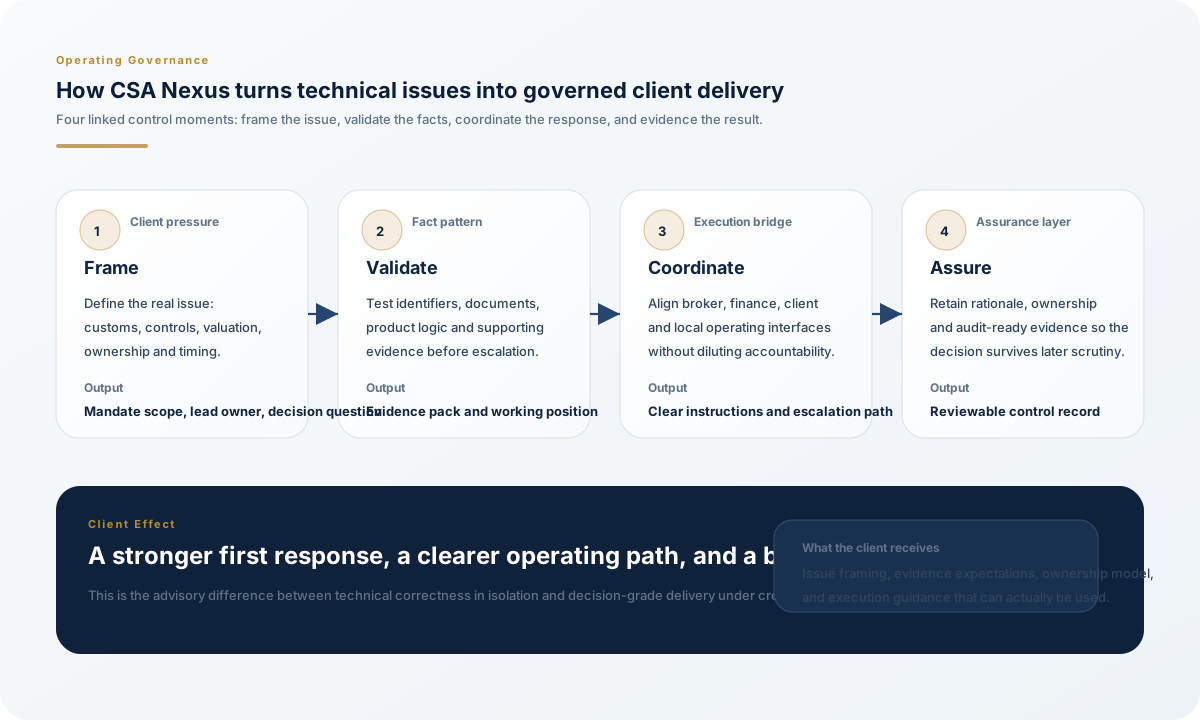
The upstream-to-border logic is part of the public offer, not background theory.
The value of the advisory layer rises when the client can see how product, origin, valuation, controls and operating ownership connect before the matter reaches customs or audit.
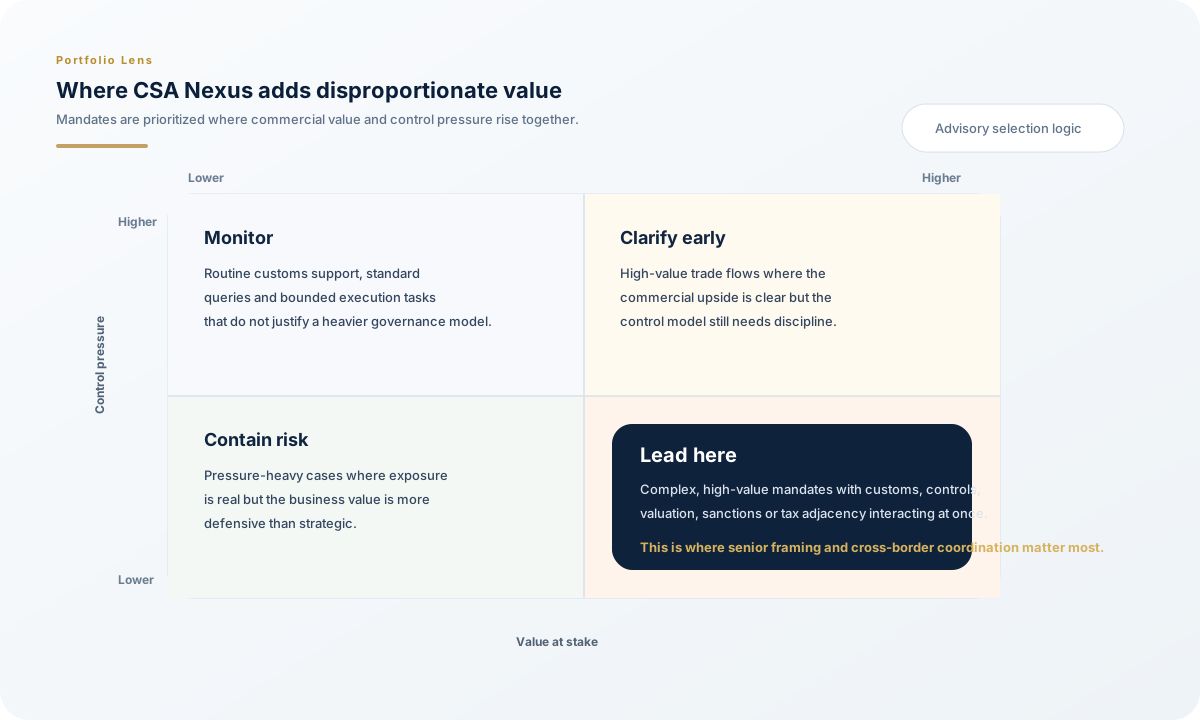
Entry work matters because it clarifies where the cost-benefit really sits.
A diagnostic should help management see whether the value lies in corridor redesign, stronger evidence, retained support or a more structured enablement layer.
Latest Updates
Strategic Governance
Trade governance becomes commercially useful only when customs, controls, valuation, origin, tax adjacency and operating ownership are connected rather than delegated into separate silos.
CSA Nexus translates technical depth into operating models, escalation logic and evidence-ready execution paths that hold under audit, shipment pressure and cross-border scrutiny. The objective is not to produce another memo that stops at the topic boundary. It is to give the client a more stable operating position across internal functions, brokers, finance teams and external counterparties.
That is why the first conversation is usually about friction rather than a generic service label: why the corridor is failing, where documentation is drifting, which decisions are not being versioned, how UK and EU responsibilities actually meet, and what needs to be brought back under clear ownership before the next shipment or review cycle.
Typical executive concerns on entry
- Customs, sanctions, origin, valuation and VAT-adjacent issues are being handled by separate teams with no shared control narrative.
- The declaration still clears, but the evidence behind the decision would not survive an audit, dispute or repeated corridor stress.
- Management can see recurring friction, but not which interface, jurisdiction or operating handoff is actually causing the repeat exceptions.

The operating model should still read clearly after the shipment has moved.
We use the governance layer to connect customs facts, release rationale, finance implications and escalation ownership into one readable mandate.
Our Capabilities
Customs, compliance and cross-border governance connected to a real operating model.
The capability mix is deliberately broad enough to reflect real trade problems, but structured enough to stay commercially readable.
Where Italy-linked operating execution is required, selected matters can be supported in coordination with CIESSE without collapsing the distinction between advisory leadership and operating delivery.
Customs, Origin & Corridor Design
Classification, origin, valuation, broker-instruction discipline and corridor logic across UK-EU and wider regulated trade flows.
Explore CustomsIndirect Tax & VAT
VAT governance, import VAT, fixed-establishment awareness, valuation alignment and finance-linked cross-border control.
Explore TaxExport Controls & Sanctions
EU and UK controls with specialist US export-control capability where extraterritorial exposure, content rules or sensitive customers make it relevant.
Explore ControlsCSA Nexus leads the advisory narrative. CIESSE strengthens the EU and Italy-side operating footing.
The relationship is presented as complementary, not absorptive. CSA Nexus remains the cross-border advisory and operating-model surface; CIESSE remains a standalone Italian and EU-facing operational company with its own commercial credibility in customs execution, documentation and compliance-aware delivery.
What this means in practice
- Most customs, trade compliance, governance, indirect-tax and export-controls capability can be discussed credibly from either surface.
- CSA Nexus leads the advisory, operating-model and cross-border architecture layer.
- CIESSE adds the distinct plus of material customs-formality execution and Italy/EU operating file control when the mandate needs it.
- The partnership increases UK-EU credibility without erasing either identity or forcing a combined mandate where none is needed.
Insights & Methodology

Method should feel like a controlled sequence, not a decorative framework.
The seven-phase logic stays, but it is presented here as an operating rhythm connected to scoping, evidence, escalation and repeat use.
The 7-Phase Integrated Cycle
From strategy and due diligence to audit readiness, KPI logic and repeatable operating discipline.
OECD Pillar Two & Customs Valuation
Understanding the interplay between transfer-pricing adjustments, customs value and the governance record needed to defend the bridge.
Aerospace repair loops, special procedures and release discipline
How special procedures, release documents, import VAT logic and escalation ownership interact in high-pressure aerospace movements.
Thought leadership should shorten the path to a client-ready mandate
The research layer is used to connect policy change, operating implications and evidence expectations before the issue becomes a costly border event or a weak board-level decision.